A wooden instrument that plays music when you rock it. Four of us built it over a semester for a class that pairs student teams with real clients. Ours ran a research lab at Brown studying how people interact with technology.
TIMELINE
Feb – May 2026
TEAM
4 undergraduate students. My focus: prototyping & building
Client
Dr. Ja-Naé Duane
CONTEXT
ENGN 0620 Design Brief, Brown School of Engineering
OVERVIEW
A sound sculpture anyone can walk up to and play with
Our client wanted an interactive sound installation. Over a semester we built a half cylinder that rocks on a curved edge. A gyroscope inside reads the motion and turns it into music. We handed off one working prototype with build documentation so her lab can make eleven more.

Volume up!
THE BRIEF
What the client needed
Our client wanted an interactive sound installation her lab could use for research and take to events. She gave us a reference project by MASARY Studios to work from and a set of requirements the piece had to meet.
Sturdy enough for free play
People should be able to push, kick, or shove it without fear of breaking it.
Works indoors and out
No fixed rig, no permanent installation, no constant maintenance.
Easy to move
It had to be able to travel relatively easily, including to other campuses.
12 notes minimum
Enough range to cover the Western chromatic scale.
Holds a space on its own
It should still be moving even when nobody is actively touching it.
Recoverable materials
Built so it can be taken apart and the materials reused.
BEFORE WE BUILT ANYTHING
What we wanted it to be
Before we explored any shapes, we ran an affinity mapping session to decide what the piece should do for the person standing in front of it. Four things came out of it, and they stayed with us through every prototype.
OUR AFFINITY MAPPING SESSION

Something you want to play with
It should read as something you can pick up and mess around with freely.
Low barrier to entry
Nobody should have to explain how to use it. You should work it out by touching it.
Calming sound
Soft synth tones rather than anything sharp or percussive.
Works alone or with others
One person should get something out of it, the same way a group would.
HOW IT MAKES SOUND
A gyroscope inside reads how fast and how far the object turns, and sends that to Logic Pro as MIDI signals.
We proposed this and settled on it with our client early on. It was cheaper than position tracking, feasible within a semester, and works without recalibration for each new space.
WHAT THAT MEANT FOR THE DESIGN
The sculpture had to invite interaction and keep moving after you let go.
FINDING THE FORM
The three shapes we kept building
Rotation gave us a starting point but we still had to find the right shape. We built eight medium-fidelity prototypes to find out which shapes people would actually move, and put working electronics in each so we could hear what they sounded like. Some were quick to rule out: a cube sits still wherever you leave it, a hanging foam ball needed a rig of its own, and the cardboard spheres took hours each to make. Three shapes were worth building properly, but none of them was an obvious winner.
SPINNING TOP
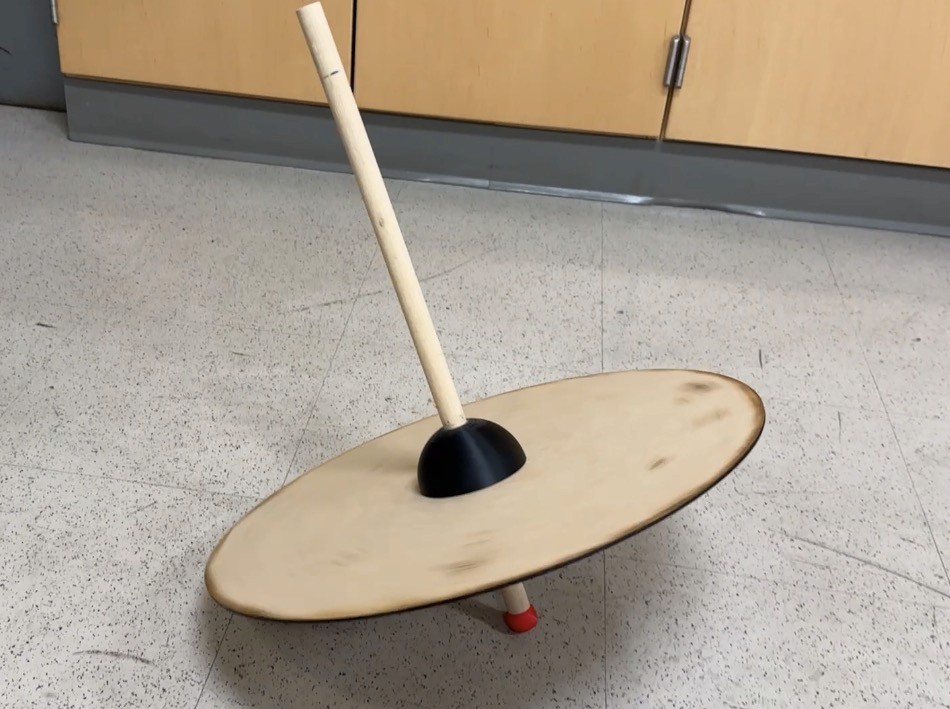
Keeps spinning a long time from one push. But it topples unless the base and shaft match exactly, and it was the hardest to hide electronics in.
GEODESIC SPHERE

Rolls in any direction which led to varied sounds. Plenty of room inside for electronics, but it moves away instead of staying relatively put.
HALF CYLINDER

Rocks on one axis and settles back where it started. Fastest to build and take apart, but one axis meant a narrower range of sound.
PUTTING THEM IN FRONT OF PEOPLE
We handed people a prototype and said nothing
We showed the prototypes to friends, to our client, and to members of her lab without explaining what they were or how they worked. Each one had electronics attached, so people heard real sound as soon as they moved something. We watched what they reached for first and what they enjoyed playing with most.
WHAT WE LEARNED
People understood the rocking shapes right away. The ones that rolled or spun needed explaining, and needing an explanation was already a failure.
THE winner
Why the half cylinder
AN IDEA WE LIKED
A set of them at different sizes
We built a smaller one alongside the full size version to see how they worked next to each other. Our client liked it, and it gives the eleven remaining pieces a reason to differ from one another instead of being eleven copies of the same object.
BUILDING IT
Two plywood semicircles and nine dowels
How it comes together
Two plywood semicircles we CNC'd form the side panels, with nine wooden dowels spanning the curved edge between them and a rectangular member across the top for support. Two 3D printed capsules sit underneath, one holding the electronics and one there for symmetry, with edges curved so they read as part of the wood rather than something stuck on.

Brown outside, blue inside
The brown exterior came out of a conversation with our TA mentor, who told us that out on the Main Green, a piece that settles into the landscape might sit better than one that fights it. The inside is a bright blue you only see once you are close enough to touch it. People in the Brown Design Workshop told us the interior made the whole thing feel playful, closer to a toy than a piece of furniture, which was the exact reaction we wanted.

Handing it off
We finished the semester with one working prototype to hand off to our client with instructions on how to reproduce it, so our her lab can produce the other eleven without us. The four of us also wrote a paper documenting the process as a final deliverable for the class.
LOOKING BACK
What we'd do differently
We had planned on three working modules and finished with one. Our professors and client encouraged us to narrow the scope rather than over-promise. The underside was meant to be a continuous curved wooden shell, but the dowels you see are what we could actually make given our time, resources, and our skill levels. We also never got to hear more than two pieces playing together; we were able to test two medium-fidelity models playing music together and it sounded great, but we never got to test the full set of 12.
What I took from this project
This was my first time working with a client who had her own constraints and reasons for wanting something to be a certain way. I got better at talking through my ideas not just within my team, but with people more experienced than me, such as our TA mentor, who was an invaluable resource for us. I also got much faster at prototyping. Making eight medium-fidelity models in a few weeks taught me to save the polish for the version that had earned it. A proof of concept can be enough to find out whether an idea works, and that is what I have carried into my work since. Finally, play was one of the principles we set out to design for, which made this entire project truly fun and fulfilling.
Explore more of my projects!